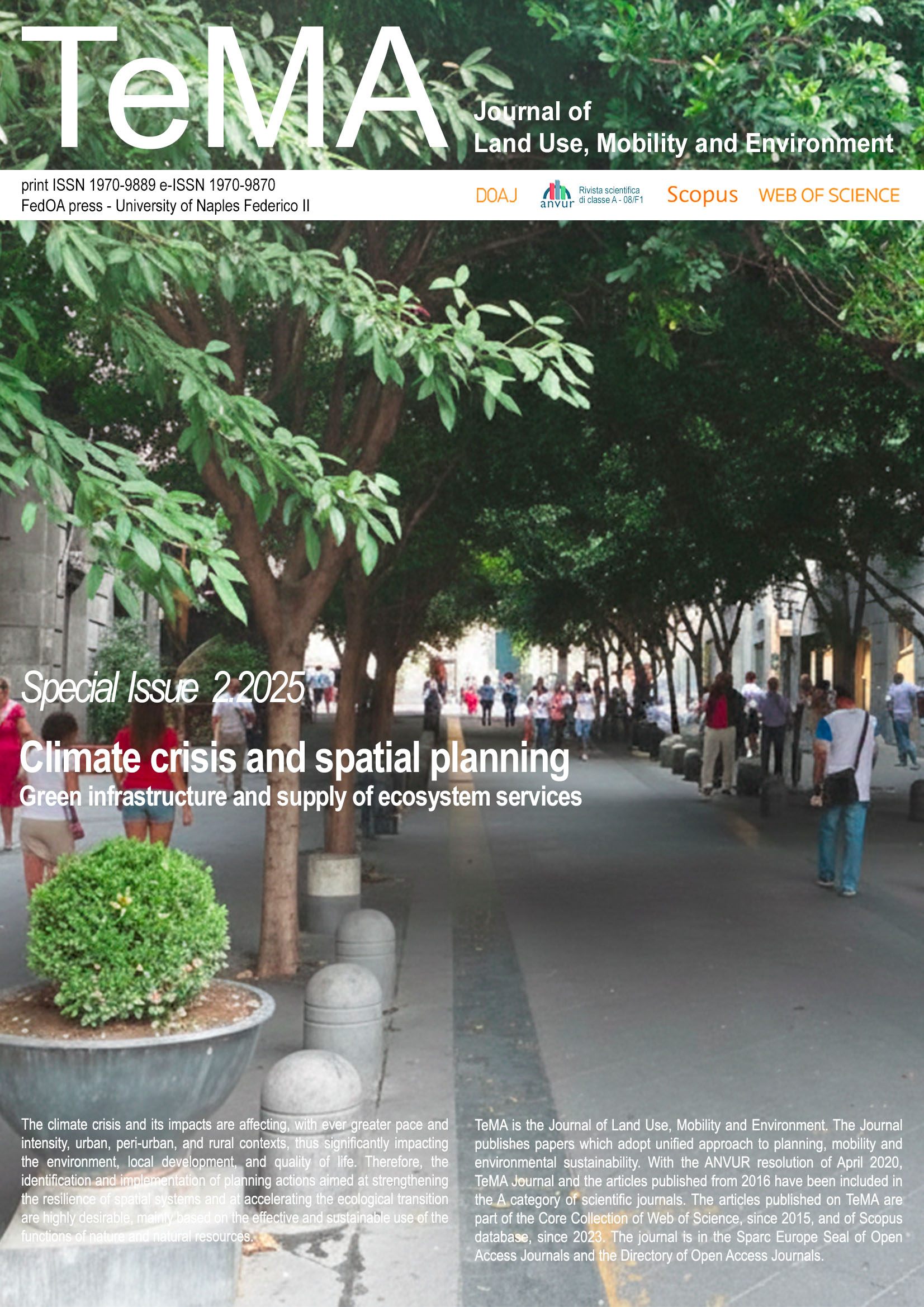
Climate crisis and spatial planning. Green infrastructure and supply of ecosystem services
DOI:
https://doi.org/10.6093/1970-9870/12807Downloads
References
Akella, A. K., Saini, R. P. & Sharma, M. P. (2009). Social, economical and environmental impacts of renewable energy systems. Renewable Energy, 34 (2), 390–396.
Ascione, L., Gargiulo, C. & Guida, C. (2025). Adaptation and energy saving through urban green spaces in climate action plans: the experiences of 20 global cities. TeMA - Journal of Land Use, Mobility and Environment, 2, 31-46. https://doi.org/10.6092/1970-9870/12081
Breuste, J.H. (2021). The Green City: From a vision to a concept from national to European perspectives. In: A. Arcidiacono & S. Ronchi (Eds.). Ecosystem Services and Green Infrastructure – Perspectives from Spatial Planning in Italy, 29-43. Cham, Switzerland: Springer.
Broto, V. C. (2017). Energy landscapes and urban trajectories towards sustainability. Energy Policy, 108, 755-764.
Buijs, A., Hansen, R., van der Jagt, S., Ambrose-Oji, B., Elands, B., Lorance Rall, E., Mattijssen, T., Pauleit, S., Runhaar, H., Stahl Olafsson, A. & Steen Møller, M. (2019) Mosaic governance for urban green infrastructure: Upscaling active citizenship from a local government perspective. Urban For. Urban Green., 40, 53–62. https://doi.org/10.1016/j.ufug.2018.06.011
De Montis, A., Martín, B., Ortega, E., Ledda, A. & Serra, V. (2017). Landscape fragmentation in Mediterranean Europe: A comparative approach. Land Use Policy, 64, 83-94.
Directorate–General Environment, European Commission (2012). The Multifunctionality of Green Infrastructure, Science for Environment Policy, DG News Alert Service, In–depth Report. Retrieved from: https://www.europarc.org/wp-content/uploads/2017/02/Green_Infrastructure.pdf. Accessed: October 1, 2025.
Echevarria Icaza, L., van der Hoeven, F. & van den Dobbelsteen, A. (2016). Surface thermal analysis of North Brabant cities and neighbourhoods during heat waves. TeMA - Journal of Land Use, Mobility and Environment, 9(1), 63-87. https://doi.org/10.6092/1970-9870/3741.
Eggermont, H., Balian, E., Azevedo, J.M.N., Beumer, V., Brodin, T., Claudet, J., Fady, B., Grube, M., Keune, H., Lamarque, P., Reuter, K., Smith, M., van Ham, C., Weisser, W.W. & Le Roux, X. (2015). Nature–based solutions: new influence for environmental management and research in Europe. GAIA Journal, 24 (4), 243-248. https://doi.org/10.14512/gaia.24.4.9
European Environment Agency (2014). Spatial Analysis of Green Infrastructure in Europe. EEA Technical Report no. 2/2014. Luxembourg: Publications Office of the European Union. https://doi.org/10.2800/11170.
Floris, M. & Zoppi, C. (2020). Ecosystem services and spatial planning: A study on the relationship between carbon sequestration and land-taking processes. Arch. Studi Urbani Reg., 51(127, supplement), 11-33. https://doi.org/10.3280/ASUR2020-127-S1002
Fors, H., Frøik Molin, J., Murphy, M.A., Konijnendijk van den Bosch, C. (2015). User participation in urban green spaces—For the people or the parks?. Urban For. Urban Green., 14 (3), 722-734. https://doi.org/10.1016/j.ufug.2015.05.007
Gargiulo, C., Stiuso, T. & Zucaro (2025). Reducing UHI in historical centres: the greening transformation of open small spaces in San Lorenzo district in the city of Naples (Italy). TeMA - Journal of Land Use, Mobility and Environment, 2, 67-87. https://doi.org/10.6092/1970-9870/12416
He, J., Huanga, J. & Li, C. (2017). The evaluation for the impact of land use change on habitat quality: A joint contribution of cellular automata scenario simulation and habitat quality assessment model. Ecol. Model., 366, 58-67. https://doi.org/10.1016/j.ecolmodel.2017.10.001
Isola, F., Kobak, B., Leccis, F., Leone, F. & Zoppi, C. (2025). Global climate crisis and regional contexts. A study on ecosystem services related to Sardinia, Italy. TeMA - Journal of Land Use, Mobility and Environment, 2, 117-134. https://doi.org/10.6092/1970-9870/11995
Isola, F., Lai, S., Leccis, F. & Leone, F. (2025). Identifying regional green infrastructure hotspots. A comparison between the Basilicata and Campania regions, Italy. TeMA - Journal of Land Use, Mobility and Environment, 2, 151-166. https://doi.org/10.6092/1970-9870/11997
Ziari, K., Ahmad, P., Molaei Qelichi, M. & Hamidi Kay, Sh. (2025). Analysis of factors affecting urban land use changes (1993-2023): a case study of Urmia City, Iran. TeMA - Journal of Land Use, Mobility and Environment, 2, 91-116. https://doi.org/10.6093/1970-987012674
Kulasegaram, P., Musthafa, M. M., Bhavan, T. & Murgante, B. (2025). Divergent stakeholder valuations of ecosystem services in Batticaloa Lagoon, Sri Lanka: implications for payment for ecosystem services frameworks for sustainable management. TeMA - Journal of Land Use, Mobility and Environment, 2, 47-66 https://doi.org/10.6092/1970-9870/12627
Lai, S., Leone, F. & Zoppi, C. (2018). Implementing green infrastructures beyond protected areas. Sustainability, 10 (10), 3544. https://doi.org/10.3390/su10103544
Lee, J. A., Chon, J. & Ahn, C. (2014). Planning landscape corridors in ecological infrastructure using least-cost path methods based on the value of ecosystem services. Sustainability, 6 (11), 7564–7585. https://doi.org/10.3390/su6117564.
Liquete, C., Kleeschulte, S., Dige, G., Maes, J., Grizzetti, B., Olah, B. & Zulian, G. (2015). Mapping green infrastructure based on eco-system services and ecological networks: A Pan–European case study. Environ. Sci. Policy, 54, 268-280. https://doi.org/10.1016/j.envsci.2015.07.009
Lv, Y., Zhang, L., Li, P., He, H., Ren, X. & Zhang, M. (2023). Ecological restoration projects enhanced terrestrial carbon sequestration in the karst region of Southwest China. Front. Ecol. Evol., 11, 1179608. https://doi.org/10.3389/fevo.2023.1179608
Martínez-Fernández, J.M., Ruiz-Benito, P. & Zavala, M.A. (2015). Recent land cover changes in Spain across biogeographical regions and protection levels: Implications for conservation policies. Land Use Policy, 44, 62-75. https://doi.org/10.1016/j.landusepol.2014.11.021
Möller, B. (2006). Changing wind-power landscapes: Regional assessment of visual impact on land use and population in Northern Jutland, Denmark. Applied Energy, 83 (5), 477-494.
Mücher, C.A., Hazeu, G.W., Swetnam, R., Gerard, F., Luque, S., Pino, J. & Halada, L. (2009). Historic land cover changes at Natura 2000 sites and their associated landscapes across Europe. In: D. Maktav (Ed.). Remote Sensing for a Changing Europe - Proceedings of the 28th Symposium of the European Association of Remote Sensing Laboratories, 226-231. Istanbul, Turkey - Amsterdam, the Netherlands: IOS Press. https://doi.org/10.3233/978-1-58603-986-8-226
Opdam, P. & Wascher, D. (2004). Climate change meets habitat fragmentation: Linking landscape and biogeographical scale levels in research and conservation. Biological Conservation, 117 (3), 285-297.
Park, S. (2017). A preliminary study on connectivity and perceived values of community green spaces. Sustainability, 9 (5), 692. https://doi.org/10.3390/su9050692
Rahmani, S., Pierri, V., Zuccaro, L. & Murgante, B. (2025). Predicting the aesthetic impact of wind turbines and their influence on landscape value. TeMA - Journal of Land Use, Mobility and Environment, 2, 135-150. https://doi.org/10.6092/1970-9870/12572
Richards, D., Etherington, T.R., Herzig, A. & Lavorel, S. (2024). The importance of spatial configuration when restoring intensive production landscapes for biodiversity and ecosystem service multifunctionality. Land, 13 (4), 460. https://doi.org/10.3390/land13040460
Romano, B., Zullo, F., Marucci, A. & Fiorini, L. (2018). Vintage urban planning in Italy: Land management with the tools of the mid-twentieth century. Sustainability, 10 (11), 4125. https://doi.org/10.3390/su10114125
Ruiz Benito, P., Cuevas, J.A., Bravo de la Parra, R., Prieto, F., García del Barrio, J.M. & Zavala, M.A. (2010). Land use change in a Medi-terranean metropolitan region and its periphery: Assessment of conservation policies through CORINE Land Cover data and Markov models. Forest Syst., 19, 315–328. https://doi.org/10.5424/fs/2010193-8604
Saganeiti, L., Favale, A., Pilogallo, A., Scorza, F. & Murgante, B. (2018). Assessing urban fragmentation at regional scale using sprinkling indexes. Sustainability, 10 (9), 3274. https://doi.org/10.3390/su10093274
Saganeiti, L., Pilogallo, A., Faruolo, G., Scorza, F. & Murgante, B. (2020). Territorial fragmentation and renewable energy source plants: Which relationship? Sustainability, 12 (5), 1828. https://doi.org/10.3390/su12051828
Saidur, R., Rahim, N. A., Islam, M. R. & Solangi, K. H. (2011). Environmental impact of wind energy. Renewable and Sustainable Energy Reviews, 15 (5), 2423–2430.
Salata, K.D. & Yiannakou, A. (2016). Green Infrastructure and climate change adaptation. TeMA - Journal of Land Use, Mobility and Environment, 9 (1), 7–24. https://doi.org/10.6092/1970-9870/3723.
Sallustio, L., De Toni, A., Strollo, A., Di Febbraro, M., Gissi, E., Casella, L., Geneletti, D., Munafò, M., Vizzarri, M. & Marchetti, M. (2017). Assessing habitat quality in relation to the spatial distribution of protected areas in Italy. J. Environ. Manag., 201, 129-137. https://doi.org/10.1016/j.jenvman.2017.06.031
Samways, M.J., Bazelet, C.S. & Pryke, J.S. (2010). Provision of ecosystem services by large scale corridors and ecological networks. Biodivers. Conserv., 19, 2949-2962. https://doi.org/10.1007/s10531-009-9715-2
Sandström, U. F. (2002). Green infrastructure planning in urban Sweden. Plann. Pract. Res., 17 (4), 373-385. https://doi.org/10.1080/02697450216356.
Schrijnen, P.M. (2000). Infrastructure networks and red-green patterns in city regions. Landsc. Urban Plan., 48 (3-4), 191–204. https://doi.org/10.1016/S0169-2046(00)00042-6
Scorza, F., Saganeiti, L., Pilogallo, A. & Murgante, B. (2020). Ghost planning: The inefficiency of energy sector policies in a low population density region. Archivio di Studi Urbani e Regionali, 127, 34-55. https://doi.org/10.3280/ASUR2020-127-S1003
Song, Z. & Liu, W. Changes in the attraction area and network structure of recreation flows in urban green, blue and grey spaces under the impact of the COVID-19 pandemic. Cities, 146, 104744. https://doi.org/10.1016/j.cities.2023.104744
Stachura, J., Chuman, T. & Šefrna, L. (2015). Development of soil consumption driven by urbanization and pattern of built-up areas in Prague periphery since the 19th century. Soil & Water Res., 10 (4), 252-261. http://doi.org/10.17221/204/2014-SWR
Tzoulas, K., Korpela, K., Venn, S., Yli-Pelikonen, V., Kaźmierczak, A., Niemela, J. & James, P. (2007). Promoting ecosystem and human health in urban areas using green infrastructure: A literature review. Landsc. Urban Plan., 81 (3), 167-178. https://doi.org/10.1016/j.landurbplan.2007.02.001.
Valente, D., Marinelli, M. V., Lovello, E. M., Giannuzzi, C. G. & Petrosillo, I. (2022). Fostering the resiliency of urban landscape through the sustainable spatial planning of green spaces. Land, 11(3), 367. https://doi.org/10.3390/land11030367
van der Ryn, S. & Cowan, S. (1996). Ecological Design. Washington, DC, United States: Island Press.
Vassilev, K., Pedashenko, H., Nikolov, S.C., Apostolova, I. & Dengler, J. (2011). Effect of land abandonment on the vegetation of up-land semi-natural grasslands in the Western Balkan Mts., Bulgaria. Plant Biosyst., 145 (3), 654-665. https://doi.org/10.1080/11263504.2011.601337
Walmsley, A. (2006). Greenways: multiplying and diversifying in the 21st century. Landsc. Urban Plan., 76 (1-4), 252–290. https://doi.org/10.1016/j.landurbplan.2004.09.036
Zhang, M., Wang, K., Liu, H., Zhang, C., Wang, J., Yue, Y. & Qi, X. (2015). How ecological restoration alters ecosystem services: an analysis of vegetation carbon sequestration in the karst area of northwest Guangxi, China. Environ Earth Sci., 74, 5307–5317. https://doi.org/10.1007/s12665-015-4542-0
Ziari, K., Kay, S. H. & Qelichi, M. M. (2025). Analysis of factors affecting urban land use changes (1993-2023): a case study of Urmia City, Iran. TeMA - Journal of Land Use, Mobility and Environment, 2, 91-116. https://doi.org/10.6092/1970-9870/12674
Zoppi, C. (2012). Valutazione come sostegno all’efficacia del piano [Assessment process as support to planning effectiveness]. In: C. Zoppi (Ed.). Valutazione e pianificazione delle trasformazioni territoriali nei processi di governance ed e-governance – Sostenibilità ed e-governance nella pianificazione del territorio [Spatial Transformations Assessment and Planning within Governance and E-Governance Processes – Sustainability and E-Governance in Spatial Planning], 13-33. Milan, Italy: FrancoAngeli.
Lai, S. & Zoppi, C. (2025). Carbon sequestration and ecosystem services. Evidence from the functional urban area of Cagliari, Italy. TeMA - Journal of Land Use, Mobility and Environment, 2, 13-29. https://doi.org/10.6092/1970-9870/11994
Downloads
Published
How to Cite
Issue
Section
License
Copyright (c) 2025 Carmela Gargiulo, Beniamino Murgante, Corrado Zoppi

This work is licensed under a Creative Commons Attribution-NonCommercial 4.0 International License.