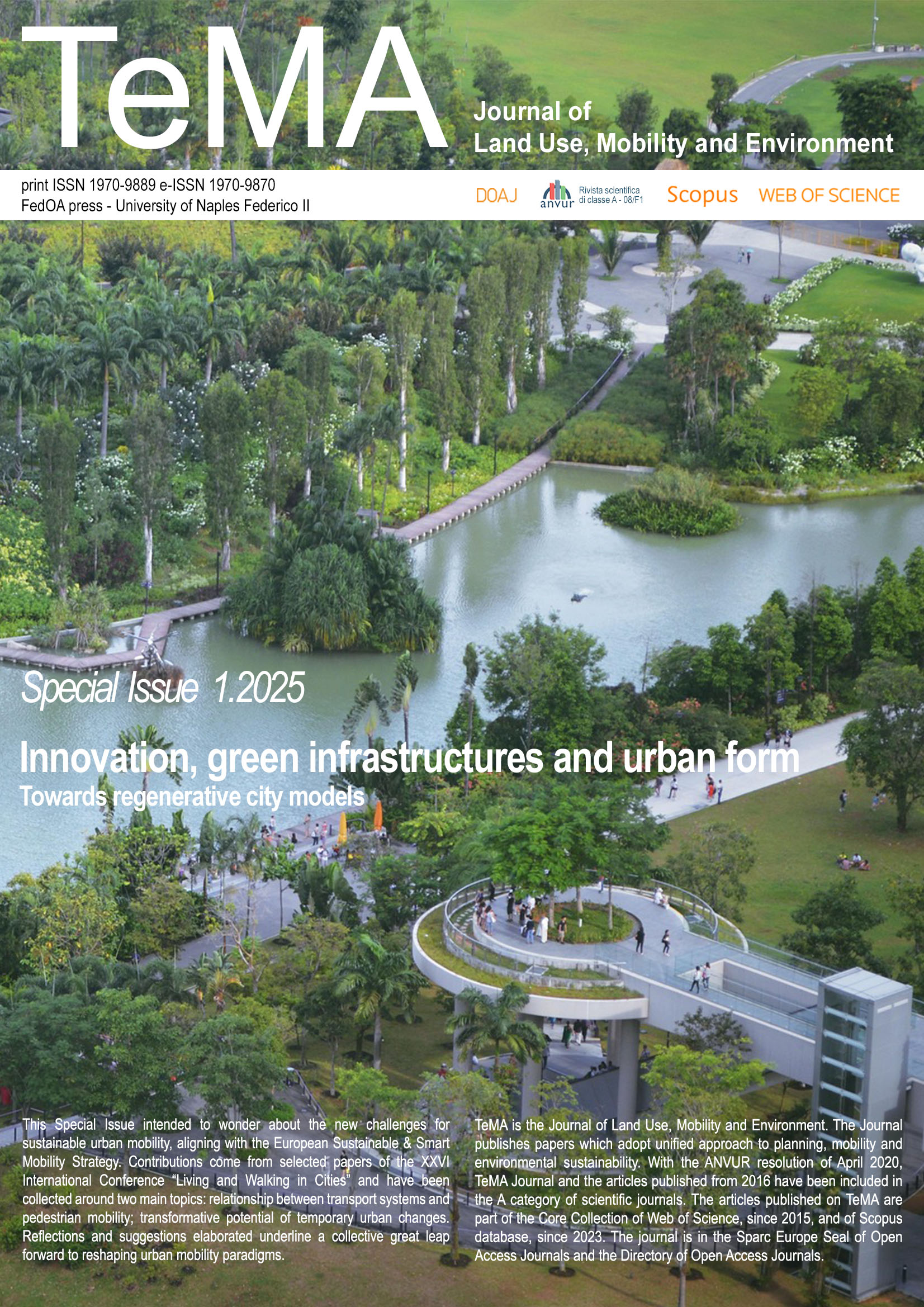
Innovation, green infrastructures and urban form. Towards regenerative city models
DOI:
https://doi.org/10.6093/1970-9870/11676Downloads
References
Ahern, J. (2011). From fail-safe to safe-to-fail: Sustainability and resilience in the new urban world. Landscape and Urban Planning, 100 (4), 341–343. https://doi.org/10.1016/j.landurbplan.2011.02.021
Alberti, M. (2018). Cities that think like planets: Complexity, resilience, and innovation in hybrid ecosystems. University of Washington Press.
Asheim, B. T., & Coenen, L. (2005). Knowledge bases and regional innovation systems: Comparing Nordic clusters. Research Policy, 34 (8), 1173–1190. https://doi.org/10.1016/j.respol.2005.03.013
Barbieri, N., Perruchas, F., & Consoli, D. (2020). Specialization, diversification, and environmental technology life cycle. Economic Geography, 96 (2), 161–186. https://doi.org/10.1080/00130095.2020.1721279
Bathri, I., & Kasliwal, A. (2019). Biophilic architecture. International Journal of Research in Engineering, Science and Management, 2(8), 580–582.
Bauman, Z. (2020). Retrotopia. Laterza.
Beatley, T. (2011). Biophilic cities: Integrating nature into urban design and planning. Island Press.
Beatley, T. (2016). Handbook of biophilic city planning and design. Island Press.
Beatley, T., & Newman, P. (2013). Biophilic cities are sustainable, resilient cities. Sustainability, 5(8), 3328–3345. https://doi.org/10.3390/su5083328
Bianconi, F., Filippucci, M., & Salvatori, C. (2018). Regenerating urban spaces: A brief commentary on green infrastructures for landscape conservation. TeMA - Journal of Land Use, Mobility and Environment, 11 (1), 107–118. https://doi.org/ 10.6092/1970-9870/5470
Boons, F., & McMeekin, A. (2019). An introduction mapping the field(s) of sustainable innovation. In F. Boons & A. McMeekin (Eds.), Handbook of sustainable innovation, 1–25. Edward Elgar Publishing.
Branco, R., Canelas, P., & Alves, S. (2024). The governance of urban regeneration in Lisbon: Drivers of continuity and change. Cities, 154, 105324. https://doi.org/10.1016/j.cities.2024.105324
Buclet, N., & Lazarevic, D. (2021). Circular neighborhoods: A path towards sustainable urban development? Journal of Cleaner Production, 316, 128164.
Canessa, N.V., Gausa, M. & Hae-Won, S. (2025). Civic Seoul 2030. Toward infrastructural renaturalization. TeMA - Journal of Land Use, Mobility and Environment, SI1, 117-128. http://dx.doi.org/10.6093/1970-9870/11176
Canzanelli, G., & Loffredo, L. (2008). Territorial systems for innovation. ILS LEDA.
Carra, M., Rossetti, S., Ignaccolo, M., Inturri, G., Le Pira, M., & Maltinti, F. (2021). Urban regeneration effects on walkability scenarios: An application of space-time assessment for the people-and-climate oriented perspective. TeMA - Journal of Land Use, Mobility and Environment, 14(3), 423–438. https://doi.org/10.6092/1970-9870/8644
Centanaro, C. & Sommariva, E. (2025). Towards bicycle infrascapes. Active mobility as an opportunity for urban regeneration and open space redesign. TeMA - Journal of Land Use, Mobility and Environment, SI1, 129-146. http://dx.doi.org/ 10.6093/1970-9870/11178
Colavitti, A.M., Floris, A. & Serra, S. (2025). The regeneration of former military sites in the context of ecological transition. The case of Cagliari, Sardinia (Italy). TeMA - Journal of Land Use, Mobility and Environment, SI1, 105-116. http://dx.doi.org/ 10.6093/1970-9870/11169
Commissione delle Comunità Europee. (1990). Libro Verde sull'ambiente urbano. Comunicazione della Commissione al Consiglio ed al Parlamento (COM90,218). Bruxelles.
Commoner, B. (1971). The closing circle: Nature, man and technology. Alfred A. Knopf.
Contato, A. & Ronsivalle, D. (2025). The Creative Co-design of Collective Spaces. Two case studies of generating new Spatial and Social Infrastructures. TeMA - Journal of Land Use, Mobility and Environment, SI1, 25-40. http://dx.doi.org/ 10.6093/1970-9870/11102
Cooke, P. (2011). Transition regions: Regional-national eco-innovation systems and strategies. Progress in Planning, 76(3), 105–146. https://doi.org/10.1016/j.progress.2011.08.002
Cutini, V., & Mara, F. Many shades of green: Intrinsic and network properties of urban green areas. TeMA - Journal of Land Use, Mobility and Environment, SI1, 147-167 https://doi.org/10.6093/1970-9870/11743
De Bonis, L., Concilio, G., Leanza, E., Marsh, J., & Trapani, F. (2014). Co-creative, re-generative smart cities: Smart cities and planning in a living lab perspective. TeMA - Journal of Land Use, Mobility and Environment, 7(1), 107–118. https://doi.org/10.6092/1970-9870/2553
De Falco, S. (2017). Le città nella geografia dell'innovazione globale. FrancoAngeli.
Edler, J., & Boon, W. P. (2018). The next generation of innovation policy: Directionality and the role of demand-oriented instruments. Science and Public Policy, 45 (4), 433–434. https://doi.org/10.1093/scipol/scy026
Errigo, M.F., Mrak, I. (2025). Vulnerable Viterbo. Ancient city form and contemporary pressures. TeMA - Journal of Land Use, Mobility and Environment, SI1, 79-90. http://dx.doi.org/10.6093/1970-9870/11139
Escolà-Gascón, Á., Dagnall, N., Drinkwater, K., & Denovan, A. (2024). Abandoned vs. regenerated places: Evidence of five social impacts that improve urban planning. Cities, 146, 104739. https://doi.org/10.1016/j.cities.2023.104739
ESPON. (2014). ET2050 – Territorial scenarios and visions for Europe. ESPON.
Esteban, R. M., Arrabal, F. C., Martínez, J. M. R., & de Salazar, N. G (2025). Problems and restoration strategies of urban mediterranean rivers in Spain.: Guadalmedina river as a potential ecological corridor in the green-blue infrastructure of Malaga, Spain. TeMA - Journal of Land Use, Mobility and Environment. https://doi.org/10.6093/1970-9870/11115
Fistola, R. (2023). Ecosystem services for the city as a complex system: A methodological proposal. Sustainability, 15 (12), 9318. https://doi.org/10.3390/su15129318
Gargiulo, C., & Papa, R. (2021). Chaos and chaos: the city as a complex phenomenon. TeMA - Journal of Land Use, Mobility and Environment, 14 (2), 261-270. https://doi.org/10.6093/1970-9870/8273
Gehl, J. (2010). Cities for people. Island Press.
Gould, S. J., & Vrba, E. S. (2008). Exaptation – Il bricolage dell'evoluzione. Bollati Boringhieri. (Traduzione italiana)
Gutierrez-Velez, V. H., MacDonald, G. K., Teneva, L., Ribbe, J., Lynch, A. J., Gornish, E. S., Blumstein, D. T., Mendenhall, C. D., Hunt, A., Green, S. J., Rhodes, C. J., & Porder, S. (2022). Beyond the 'urban' and the 'rural': Conceptualizing a new generation of infrastructure systems to enable rural–urban sustainability. Current Opinion in Environmental Sustainability, 56, Article 101177. https://doi.org/10.1016/j.cosust.2022.101177
Hall, P. (2014). Cities of tomorrow: An intellectual history of urban planning and design since 1880 (4th ed.). Wiley-Blackwell.
Kellert, S. R., & Wilson, E. O. (Eds.). (1993). The biophilia hypothesis. Island Press.
Köhler, J., Geels, F. W., Kern, F., Markard, J., Onsongo, E., Wieczorek, A., Alkemade, F., Avelino, F., Bergek, A., Boons, F., Fünfschilling, L., Hess, D., Holtz, G., Hyysalo, S., Jenkins, K., Kivimaa, P., Martiskainen, M., McMeekin, A., Mühlemeier, M. S., ... Wells, P. (2019). An agenda for sustainability transition research: State of the art and future directions. Environmental Innovation and Societal Transitions, 31, 1–32. https://doi.org/10.1016/j.eist.2019.01.004
La Foresta, D. (2021). L'innovazione come leva per lo sviluppo territoriale. Geotema, 65, 116–125.
Lefosse, D., van Timmeren, A., & Ratti, C. (2023). Biophilia upscaling: A systematic literature review based on a three-metric approach. Sustainability, 15 (22), Article 15702. https://doi.org/10.3390/su152215702
Lemes De Oliveira, F. (2020). Green wedge urbanism: History, theory and contemporary practice. Bloomsbury Academic.
Markard, J., Raven, R., & Truffer, B. (2012). Sustainability transitions: An emerging field of research and its prospects. Research Policy, 41 (6), 955–967. https://doi.org/10.1016/j.respol.2012.02.013
Mora-Esteban, R., Conejo-Arrabal, F., Romero-Martínez, J. M., & Nebot-Gómez de Salazar, N. (2025). Problems and restoration strategies of urban mediterranean rivers in Spain. TeMA - Journal of Land Use, Mobility and Environment, SI1, 55-77. http://dx.doi.org/10.6093/1970-9870/11115
Moraci, F., Bevilacqua, C., & Pizzimenti, P. (2024). Planning the transition of cities: Innovative research approaches and trajectories. TeMA - Journal of Land Use, Mobility and Environment, 17 (1), 169–190. https://doi.org/10.6092/1970-9870/10430
Moreno, C. (2024). The 15-minute city: A solution for saving our time & our planet. John Wiley & Sons.
Nakajima, H., & Murayama, A. (2024). Inclusive urban regeneration approaches through small projects: A comparative study of three Japanese machizukuri cases. Cities, 152, 105241. https://doi.org/10.1016/j.cities.2024.105241
Newman, P., Beatley, T., & Boyer, H. (2017). Build biophilic urbanism in the city and its bioregion. In T. Beatley, D. Dodson, & Y. Y. Newman (Eds.), Resilient cities: Overcoming fossil fuel dependence, 127–153. Island Press.
Oh, J., Li, M., & Jung, J. (2024). Response to shrinking cities: Cultural urban regeneration. Cities, 155, 105447. https://doi.org/10.1016/j.cities.2024.105447
Papa, R., Battarra, R., Fistola, R. & GargiuloC. (2021). The city as a complex system in structural crisis. TeMA - Journal of Land Use, Mobility and Environment, 14 (3), 455-491. https://doi.org/10.6093/1970-9870/8696
Pellecchia, M. T., Frasca, M., Citarella, A. A., Risi, M., Francese, R., Tortora, G., & De Marco, F. (2019). Identifying correlations among biomedical data through information retrieval techniques. In 2019 23rd International Conference Information Visualisation (IV), 269–274. IEEE. https://doi.org/10.1109/IV.2019.00052
Pidalà, A. M. (2025). PED’s paradigm shift as regenerative city models between innovation, green infrastructures and urban form. TeMA – Journal of Land Use, Moblity and Environement, SI1, 41-53. http://dx.doi.org/10.6093/1970-9870/11103
Prado-Acebo, C. & Río Vázquez, A. S. (2025). Green and revitalised cities through the universities: Sarzano and Ferrol campus. TeMA - Journal of Land Use, Mobility and Environment, SI1, 13-24. http://dx.doi.org/10.6093/1970-9870/11085
Rueda, S. (2019). Superblocks for the design of new cities and renovation of existing ones. In Urban visions: From planning to design, 135-154. Springer. https://doi.org/10.1007/978-3-030-01812-2_8
Salmond, J. A., Tadaki, M., Vardoulakis, S., Arbuthnott, K., Coutts, A., Demuzere, M., Dirks, K. N., Heaviside, C., Lim, S., Macintyre, H., McInnes, R. N., & Wheeler, B. W. (2016). Health and climate related ecosystem services provided by street trees in the urban environment. Environmental Health, 15 (Suppl 1), 95. https://doi.org/10.1186/s12940-016-0103-6
Sanfilippo, F., Rossi, F., Tuccio, T., Cavigli, L., Querzoli, G., Blecic, I., Saiu, V., Matteini, P. (2025). An innovative tool for supporting urban policies: assessing the health of mediterranean urban greenery with portable optical technologies and vegetation metrics. TeMA - Journal of Land Use, Mobility and Environment, SI1, 91-104. http://dx.doi.org/10.6093/1970-9870/11163
Scaffidi, F. (2024). Average social and territorial innovation impacts of industrial heritage regeneration. Cities, 148, 104907. https://doi.org/10.1016/j.cities.2024.104907
Schumpeter, J. A. (1954). Capitalism, socialism and democracy. Allen & Unwin.
Sgambati, S. (2022). The interventions of the Italian Recovery and Resilience Plan: Urban regeneration of the Italian cities. TeMA - Journal of Land Use, Mobility and Environment, 15 (3), 501–506. https://doi.org/10.6092/1970-9870/8982
Sharifi, A., & Yamagata, Y. (Eds.). (2018). Resilience-oriented urban planning. Springer. https://doi.org/10.1007/978-3-319-75798-8
Thomson, G., & Newman, P. (2021). Green infrastructure and biophilic urbanism as tools for integrating resource efficient and ecological cities. Urban Planning, 6 (1), 75-88. https://doi.org/10.17645/up.v6i1.3573
Trupiano, G., & Fistola, R. (1989). Gestione delle risorse naturali e progettazione degli spazi verdi. Atena.
Tzoulas, K., Korpela, K., Venn, S., Yli-Pelkonen, V., Kaźmierczak, A., Niemela, J., & James, P. (2007). Promoting ecosystem and human health in urban areas using green infrastructure: A literature review. Landscape and Urban Planning, 81(3), 167–178. https://doi.org/10.1016/j.landurbplan.2007.02.001
Valente, D., Pasimeni, M. R., Petrosillo, I., Zurlini, G., Cavallo, A., & Aretano, R. (2020). The role of green infrastructures in Italian cities by linking natural and social capital. Ecological Indicators, 108, 105694. https://doi.org/ 10.1016/j.ecolind.2019.105694
Zari, M. P. (2018). Regenerative urban design and ecosystem biomimicry. Routledge. https://doi.org/10.4324/ 9781315114330
Downloads
Published
How to Cite
Issue
Section
License
Copyright (c) 2025 Giampiero Lombardini, Romano Fistola, Giorgia Tucci, Carmen Guida

This work is licensed under a Creative Commons Attribution-NonCommercial 4.0 International License.