Exploring open and green space characteristics for climate change adaptation: a focus on energy consumption
DOI:
https://doi.org/10.6093/1970-9870/12723Keywords:
Open Space, Green Areas, Literature Review, Climate Change Adaptation, Energy ConsumptionAbstract
Starting from the relationship between urban planning and mobility management, TeMA has gradually expanded the view of the covered topics, always remaining in the groove of rigorous scientific in-depth analysis. This section of the Journal, Review Notes, is the expression of continuously updating emerging topics concerning relationships between urban planning, mobility, and environment, through a collection of short scientific papers written by young researchers. The Review Notes are made of five parts. Each section examines a specific aspect of the broader information storage within the main interests of TeMA Journal. In particular, the Urban planning literature review section presents recent books and journals on selected topics and issues within the global scientific panorama.
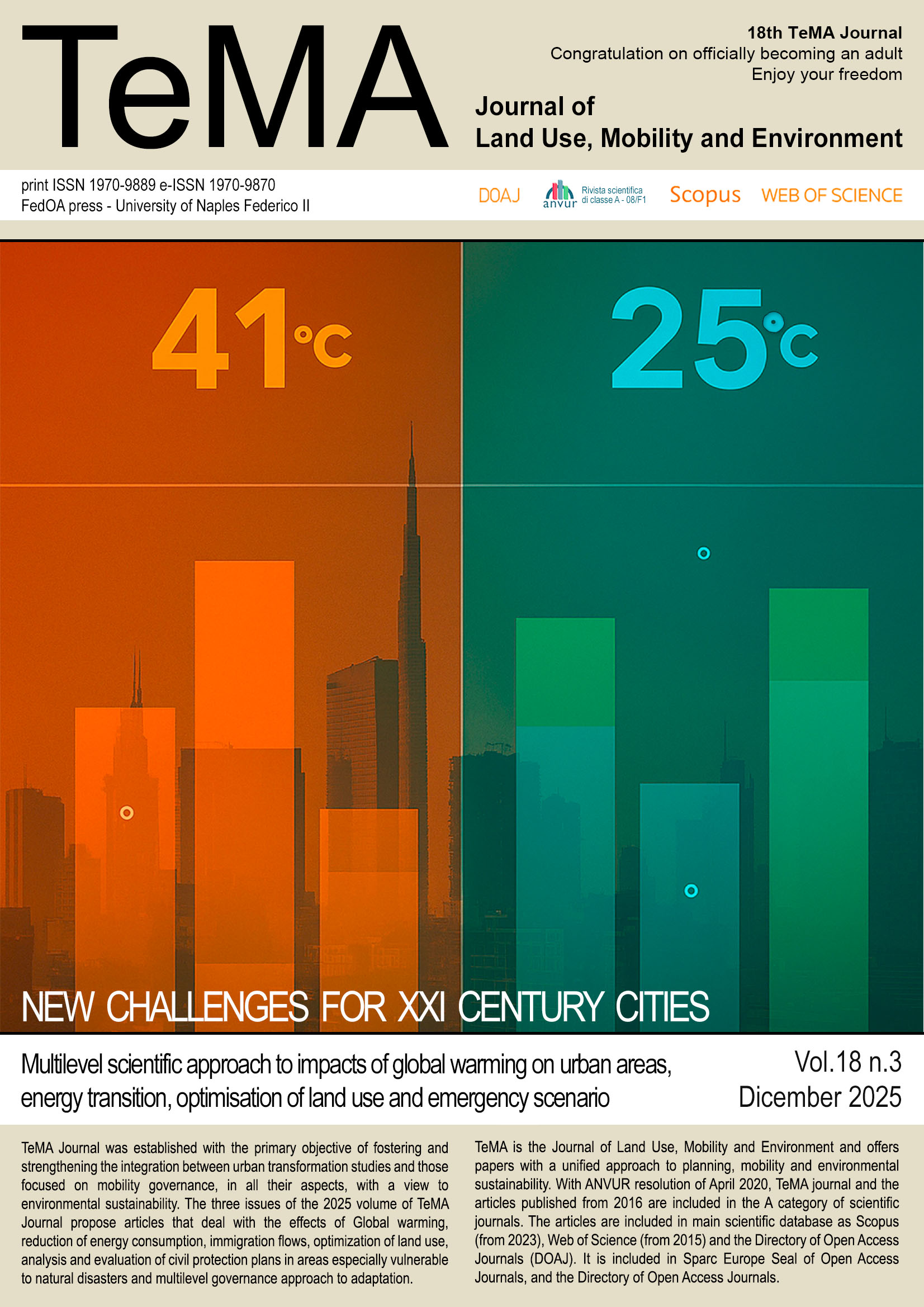
For the third issue of TeMA Journal volume no. 18, this section provides a comprehensive overview of the challenges and solutions related to the role of open and green spaces in climate change adaptation, with particular attention to the urban energy consumption. Using a variety of scientific sources and practical resources, this contribution aims to identify the key characteristics of these spaces that can influence adaptation strategies, examining the solutions proposed in the scientific literature, specifically in books, journals, and reports.
For the third issue of TeMA Journal volume no. 18, this section provides a comprehensive overview of the challenges and solutions related to the role of open and green spaces in climate change adaptation, with particular attention to the urban energy consumption. Using a variety of scientific sources and practical resources, this contribution aims to identify the key characteristics of these spaces that can influence adaptation strategies, examining the solutions proposed in the scientific literature, specifically in books, journals, and reports.
Downloads
References
Ascione, L., Gargiulo, C., & Guida, C. (2025). A systematic review of climate action plans: A focus on urban green spaces for adaptation and energy saving. In O. Gervasi et al. (Eds.), Computational Science and Its Applications – ICCSA 2025 Workshops (Lecture Notes in Computer Science, Vol. 15890, pp. 106–121). Springer Nature Switzerland. https://doi.org/10.1007/978-3-031-97606-3_8
Camerin, F., Álvarez-Del-Valle, L., Díez-Bermejo, A., & Rodríguez-Suárez, I. (2024). Towards the Spanish local urban agenda: The evolution of urban regeneration in Spain (2014–2022). TeMA: Journal of Land Use, Mobility and Environment, 17(1), 51–70. https://doi.org/10.6093/1970-9870/10338
Caneparo, L., & Rolfo, D. (s.d.). From energy renovation to urban renovation. Agenzia delle Entrate. https://www.agenziaentrate.gov.it/portale/documents/20143/325307/From+energy+renovation+to+urban+renovation+Davide+Rolfo_CaneparoRolfo_ing.pdf/3ecbe591-dd8d-7880-1e70-eddb210d30af
Carpentieri, G., Gargiulo, C., Stiuso, T., Zucaro, F. (2024). Greening and Cooling Urban Areas: The Open Space System Contribution for Energy Saving and Climate Change Adaptation. In: Gervasi, O., Murgante, B., Garau, C., Taniar, D., C. Rocha, A.M.A., Faginas Lago, M.N. (eds) Computational Science and Its Applications – ICCSA 2024 Workshops. ICCSA 2024. Lecture Notes in Computer Science, vol 14818. Springer, Cham. https://doi.org/10.1007/978-3-031-65273-8_27 2. 2024
Council of the European Union. (2020). Biodiversity. https://www.consilium.europa.eu/it/policies/biodiversity/
European Commission. 2019. The European Green Deal. https://commission.europa.eu/strategy-and-policy/priorities-2019-2024/european-green-deal_it
European Commission. (2021). Building a climate-resilient future – A new EU strategy on adaptation to climate change [Press release]. https://ec.europa.eu/commission/presscorner/detail/it/ip_21_663
European Commission. (2021). Reference documents – Horizon Europe (2021–2027). EU Funding & Tenders Portal. https://ec.europa.eu/info/funding-tenders/opportunities/portal/screen/how-to-participate/reference-documents;programCode=HORIZON
Giannakidou, A., & Latinopoulos, D. (2023). Identifying spatial variation in the values of urban green at the city level. TeMA: Journal of Land Use, Mobility and Environment, 16(1), 83–104. https://doi.org/10.6093/1970-9870/9290
Guida, C. (2022). Energy saving and efficiency in urban environments: integration strategies and best practices. TeMA-Journal of Land Use, Mobility and Environment, 15(3), 517-531.
He, Q., Tapia, F., & Reith, A. (2023). Quantifying the influence of nature-based solutions on building cooling and heating energy demand: A climate specific review. Renewable and Sustainable Energy Reviews, 186, 113660. https://doi.org/10.1016/j.rser.2023.113660
Marando, F., Heris, M. P., Zulian, G., Udías, A., Mentaschi, L., Chrysoulakis, N., Parastatidis, D., & Maes, J. (2022). Urban heat island mitigation by green infrastructure in European Functional Urban Areas. Sustainable Cities and Society, 77, 103564. https://doi.org/10.1016/j.scs.2021.103564
Massaro, E., Schifanella, R., Piccardo, M. et al. Spatially-optimized urban greening for reduction of population exposure to land surface temperature extremes. Nat Commun 14, 2903 (2023). https://doi.org/10.1038/s41467-023-38596-1
Mazzeo, G., & Polverino, S. (2023). Nature-based solution for climate change adaptation and mitigation in urban areas with high natural risk. TeMA: Journal of Land Use, Mobility and Environment, 16(2), 111–130. https://doi.org/10.6093/1970-9870/10094
Ministero dell’Ambiente e della Sicurezza Energetica. (2024). Programma LIFE. https://www.mase.gov.it/portale/programma-life
Pultrone, G. (2023). The city challenges and the new frontiers of urban planning. TeMA: Journal of Land Use, Mobility and Environment, 16(1), 27–45. https://doi.org/10.6093/1970-9870/9392
Razzaghi Asl, S. (2022). Re-powering the nature-intensive systems: A conceptual framework for coupling nature-based solutions and energy transition. Frontiers in Sustainable Cities, 4, Article 860914. https://www.frontiersin.org/articles/10.3389/frsc.2022.860914/full
Sgambati, S., & Stiuso, T. (2023). The interventions of the Italian Recovery and Resilience Plan: Digitalization in cities. TeMA: Journal of Land Use, Mobility and Environment, 16(1), 245–250
UNEP Copenhagen Climate Centre. (2023). Urgent call to action: Leveraging energy efficiency and nature-based solutions amid record heatwaves. https://unepccc.org/urgent-call-to-action-leveraging-energy-efficiency-and-nature-based-solutions-amid-record-heatwaves/
UNFCCC. (2015). Accordo di Parigi. Framework Convention on Climate Change. Paris: United Nations.
UN. (2015). Trasformare il nostro mondo: l'Agenda 2030 per lo Sviluppo Sostenibile. New York: United Nations General Assembly.
Zhang, B., Xie, G., Gao, J., & Yang, Y. (2014). The cooling effect of urban green spaces as a contribution to energy-saving and emission-reduction: A case study in Beijing, China. Building and Environment, 76, 37–43. https://doi.org/10.1016/j.buildenv.2014.03.003
Downloads
Published
How to Cite
Issue
Section
License
Copyright (c) 2025 Tonia Stiuso

This work is licensed under a Creative Commons Attribution-NonCommercial 4.0 International License.