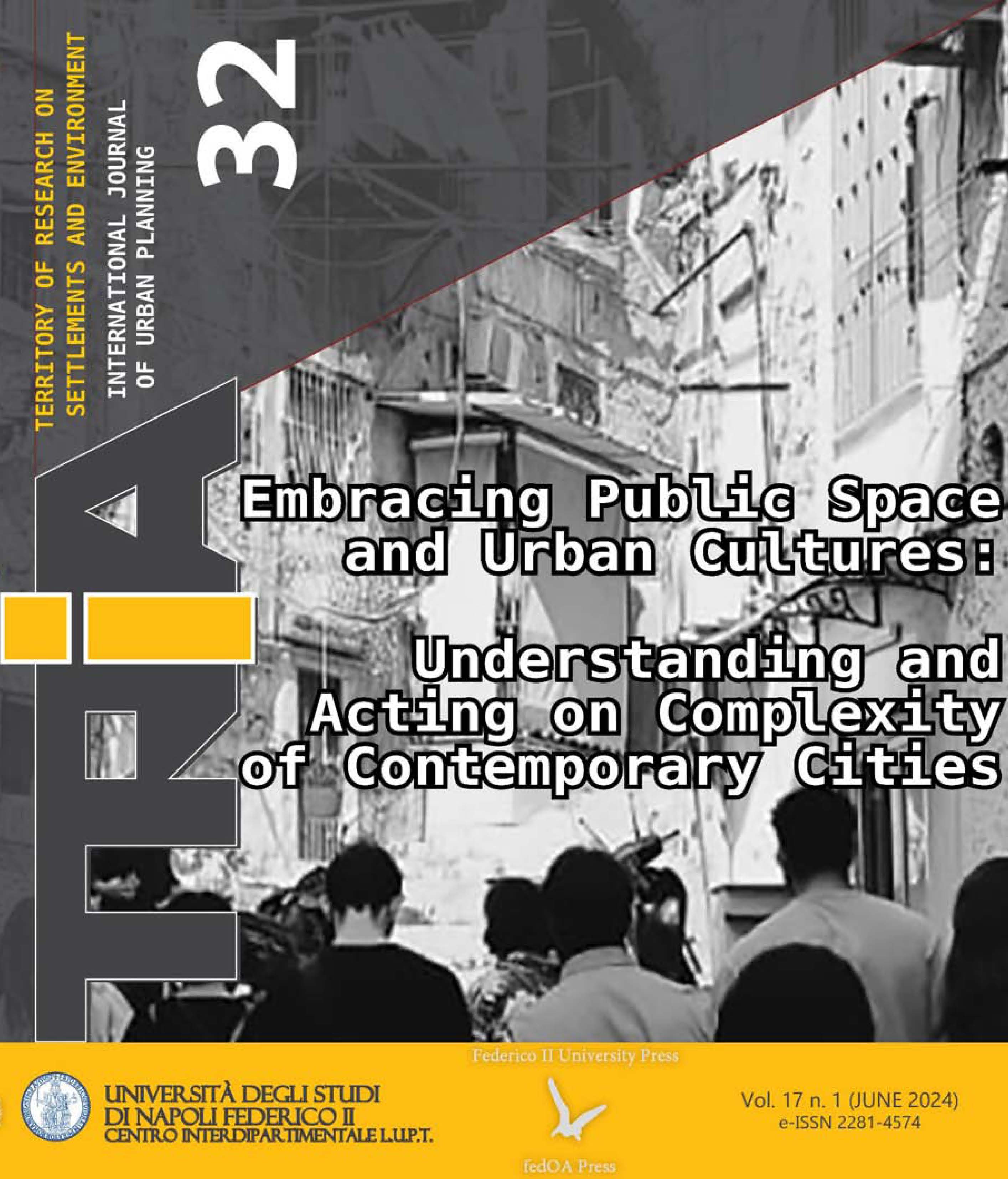
Public space in the digital age, segregation and urban unease in metropolitan cities
DOI:
https://doi.org/10.6093/2281-4574/11104Abstract
Public space is any place owned or used by the public that is available to all free of charge. It has its own spatial, environmental and economic characteristics. The speed of social changes and modes of communication, and the spread of digitalisation for the use of services and public spaces have given impetus to major urban transformations, relating both to ways of experiencing cities and to the complex of forms and rules for structuring public spaces. The essay defines the characteristics of public space, exclusionary factors dependent on territorial location (centre/periphery) and digitisation-induced changes in the quality of relations and cultural phenomena. Suburbs and metropolises are becoming increasingly segregating.
Public spaces, born to be inclusive, are increasingly becoming spaces of transit, sometimes giving a discouraging picture of social and urban conditions. There are public spaces characterised by a slow process of adaptation to the speed of the demands that contemporary society expresses. In these cases, public spaces fail to fulfil their social 'mandate'. The reasons for the lack of attractiveness of public spaces are described in the essay together with the preconditions for overcoming the crisis of representativeness. In the suburbs of Italian metropolitan cities there is a greater presence of disadvantaged and vulnerable families. The article proposes some reflections to rethink the relationship public spaces-city-environment-society in the era of great transitions.
Downloads
Downloads
Published
Issue
Section
License
Gli autori che pubblicano su questa rivista accettano le seguenti condizioni:- Gli autori mantengono i diritti sulla loro opera e cedono alla rivista il diritto di prima pubblicazione dell'opera, contemporaneamente licenziata sotto una Licenza Creative Commons - Attribuzione che permette ad altri di condividere l'opera indicando la paternità intellettuale e la prima pubblicazione su questa rivista.
- Gli autori possono aderire ad altri accordi di licenza non esclusiva per la distribuzione della versione dell'opera pubblicata (es. depositarla in un archivio istituzionale o pubblicarla in una monografia), a patto di indicare che la prima pubblicazione è avvenuta su questa rivista.
- Gli autori possono diffondere la loro opera online (es. in repository istituzionali o nel loro sito web) prima e durante il processo di submission, poiché può portare a scambi produttivi e aumentare le citazioni dell'opera pubblicata (Vedi The Effect of Open Access).