Mapping socio-economic inequalities in the city of Naples: a spatial analysis through the gender dimension
DOI:
https://doi.org/10.6093/2281-4574/12933Abstract
In the domain of urban studies, the analysis of inequalities has assumed increasing significance, given the close linkage between the spatial configurations of the city and the social and economic processes that determine their perpetuation.
A critical reflection on the relationship between urban form and social justice, as well as on the right to the city, has guided urban planning practices towards the implementation of redistributive policies. The objective of these policies is to strengthen urban welfare. This is complemented by a perspective that focuses on individual differences – particularly in terms of gender, age and ability – in shaping access to and use of urban space, and in determining the extent to which the right to the city can be exercised.
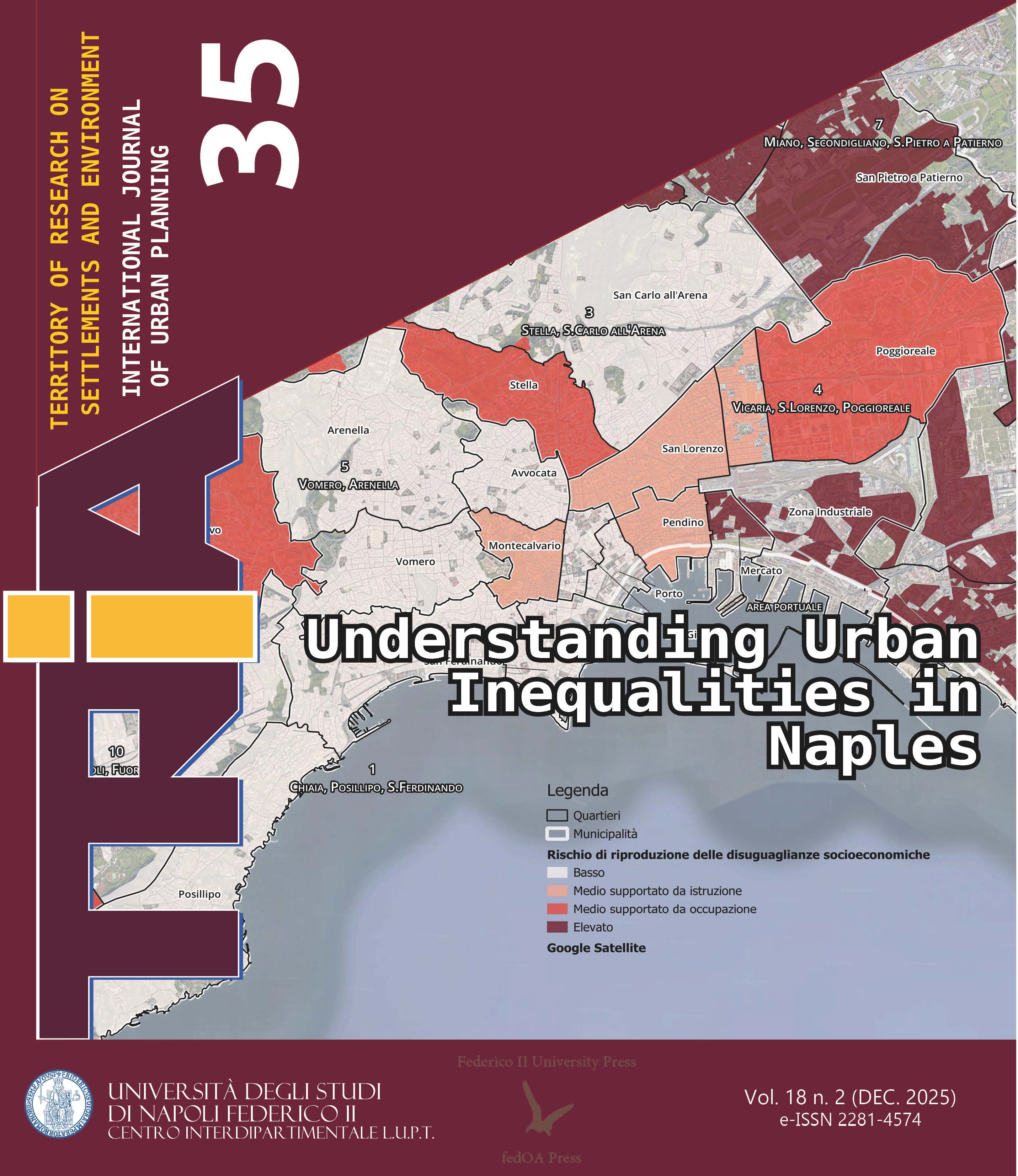
At the intersection of these two approaches, this contribution — developed as part of the PRIN research project “Mapping the new spatial inequalities within Southern European cities” — presents an analysis of socio-economic inequalities in the city of Naples, utilising spatial analysis techniques within a Geographic Information System (GIS) environment.
The present study focuses on two variables considered to be protective factors against the reproduction of inequalities, namely educational attainment and employment status. The study examines the distribution of these variables among the female population. The objective of this study is to produce a geography of gender-based inequalities by identifying patterns of spatial homogeneity and heterogeneity, with a view to mapping urban areas characterised by higher levels of socio-economic vulnerability.
Downloads
Downloads
Published
Issue
Section
License
Copyright (c) 2025 Antonia Arena

This work is licensed under a Creative Commons Attribution 4.0 International License.
Gli autori che pubblicano su questa rivista accettano le seguenti condizioni:- Gli autori mantengono i diritti sulla loro opera e cedono alla rivista il diritto di prima pubblicazione dell'opera, contemporaneamente licenziata sotto una Licenza Creative Commons - Attribuzione che permette ad altri di condividere l'opera indicando la paternità intellettuale e la prima pubblicazione su questa rivista.
- Gli autori possono aderire ad altri accordi di licenza non esclusiva per la distribuzione della versione dell'opera pubblicata (es. depositarla in un archivio istituzionale o pubblicarla in una monografia), a patto di indicare che la prima pubblicazione è avvenuta su questa rivista.
- Gli autori possono diffondere la loro opera online (es. in repository istituzionali o nel loro sito web) prima e durante il processo di submission, poiché può portare a scambi produttivi e aumentare le citazioni dell'opera pubblicata (Vedi The Effect of Open Access).