Crime: impacts of urban design and environment
DOI:
https://doi.org/10.6092/2281-4574/1788Keywords:
crime, urban design, environmentAbstract
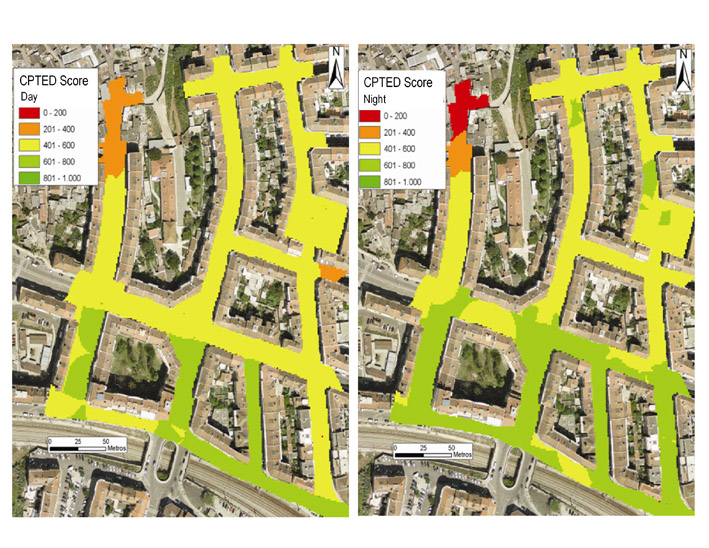
The criminal research has confirmed that there are clear patterns of crime, with concentrations in specific places at specific times. That is to say, incidence of crime are not distributed randomly; rather, there are certain areas in cities that are relatively small, but where crimes occur much more frequently than elsewhere (the so-called “hotspots”), making them highly vulnerable and predictable. Urban design and environment may play a part in the decision of whether or not to commit a crime; for example, the lack of natural vigilance, poor lighting and other variables mean that a small area may easily be transformed into a potential crime hotspot. The relationship between specific aspects of urban design and the formation of “hotspots” is present in the theory of “Crime Prevention through Environmental Design” (CPTED).
This paper examines the relationship between the “hotspots” and the characteristics of the environment, in accordance with CPTED Index, in one city from the Lisbon Metropolitan Area (Amadora). The results highlight the need to reassess specific elements of urban design. This fact has drawn attention to the study of localities and urban design.
Downloads
Downloads
Published
Issue
Section
License
Gli autori che pubblicano su questa rivista accettano le seguenti condizioni:- Gli autori mantengono i diritti sulla loro opera e cedono alla rivista il diritto di prima pubblicazione dell'opera, contemporaneamente licenziata sotto una Licenza Creative Commons - Attribuzione che permette ad altri di condividere l'opera indicando la paternità intellettuale e la prima pubblicazione su questa rivista.
- Gli autori possono aderire ad altri accordi di licenza non esclusiva per la distribuzione della versione dell'opera pubblicata (es. depositarla in un archivio istituzionale o pubblicarla in una monografia), a patto di indicare che la prima pubblicazione è avvenuta su questa rivista.
- Gli autori possono diffondere la loro opera online (es. in repository istituzionali o nel loro sito web) prima e durante il processo di submission, poiché può portare a scambi produttivi e aumentare le citazioni dell'opera pubblicata (Vedi The Effect of Open Access).