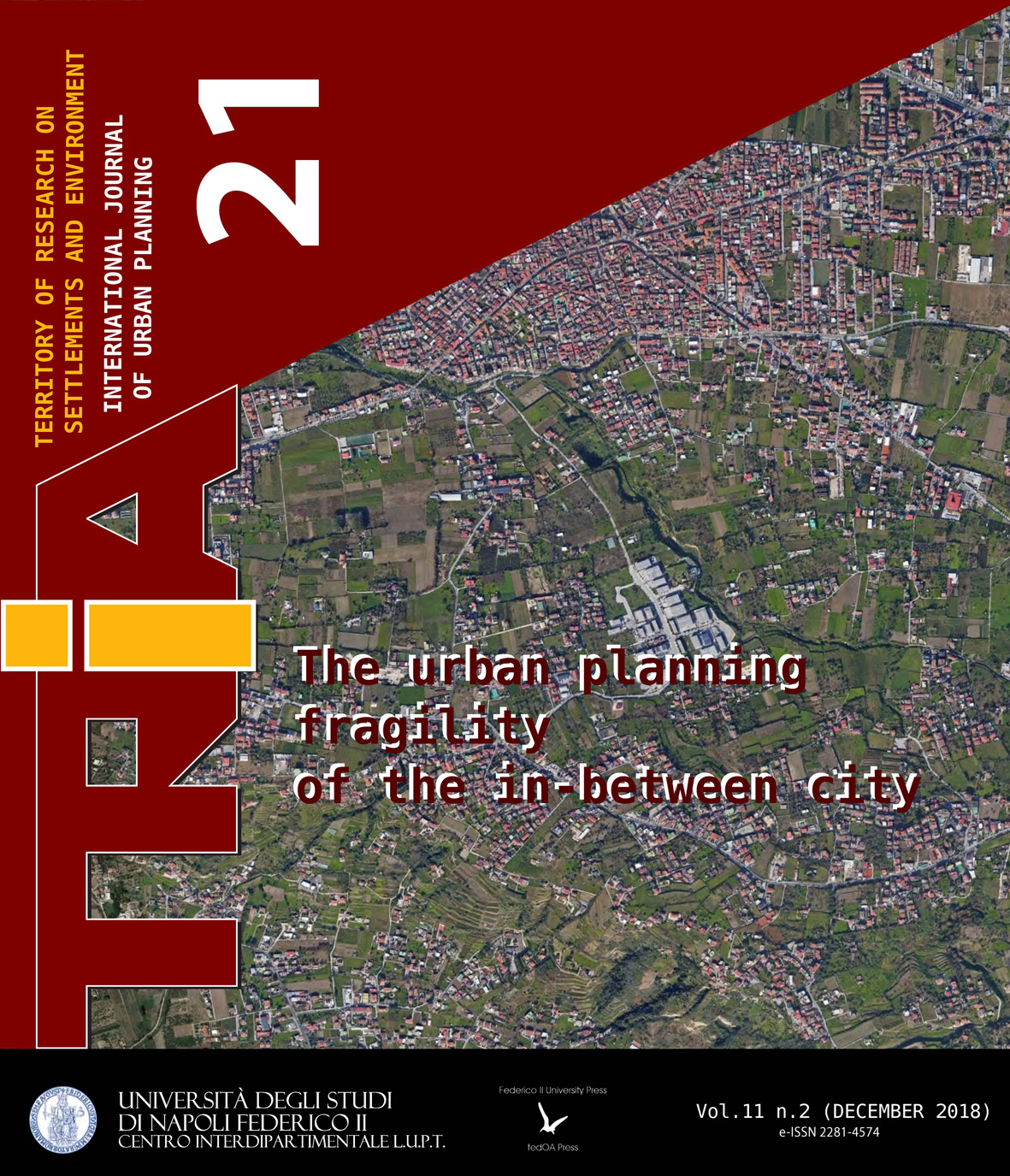
The in-between city. A fragile present between the recent past and the remote past
DOI:
https://doi.org/10.6092/2281-4574/6096Abstract
Urban decay regards not only the urban agglomeration - particularly the central area where the richness of its historical, architectural and artistic heritage represents the driving force of its social, economic and cultural vitality - nor the social housing neighbourhoods in the peripheries widely investigated in the last four decades, but above all the fragmented areas developed in-between the two mentioned models. The “in-between city” represents an intermediate area where the abandonment of agriculture has left spaces to unplanned models of settlements, such as the residential illegal housing (in Italy often defined as “illegal construction for necessity”), or the property and building speculation raised after the Second World War, often supported by the absence of planning governance.
The “abandoned areas” left over by urban planning, being less accessible for infrastructural deficiency or because of their morphology, not classifiable as “urban voids”, or “transformation areas” or “areas without plans”, were considered excessively fragmented to be planned by traditional planning schools that continued to classify them as rural areas. These neglected areas have been exposed to a process of social, economic, landscape and environmental degradation, changing their positive urban features, especially the attractiveness deriving from their close position to the city centre, into negative ones. The growth of these neglected spaces, which we define “in-between city”, produced an indeterminate space characterized by precarious neighbourhoods, without planning and urban design strategy, not even involved in restoration, renovation and rehabilitation (environmental, social, economic and cultural) of the settlement asset. Nevertheless, the “in-between city”, as a product of the failure of urban planning and design, has independently developed with the same fragility that has marked its genesis, remaining in silent expectation for a newly positive role of socio-economic and cultural mediation into the wider urban system through adequate projects.
Downloads
Additional Files
Published
Issue
Section
License
Gli autori che pubblicano su questa rivista accettano le seguenti condizioni:- Gli autori mantengono i diritti sulla loro opera e cedono alla rivista il diritto di prima pubblicazione dell'opera, contemporaneamente licenziata sotto una Licenza Creative Commons - Attribuzione che permette ad altri di condividere l'opera indicando la paternità intellettuale e la prima pubblicazione su questa rivista.
- Gli autori possono aderire ad altri accordi di licenza non esclusiva per la distribuzione della versione dell'opera pubblicata (es. depositarla in un archivio istituzionale o pubblicarla in una monografia), a patto di indicare che la prima pubblicazione è avvenuta su questa rivista.
- Gli autori possono diffondere la loro opera online (es. in repository istituzionali o nel loro sito web) prima e durante il processo di submission, poiché può portare a scambi produttivi e aumentare le citazioni dell'opera pubblicata (Vedi The Effect of Open Access).