Urban and social regeneration: the case of Monterusciello Agro-City
DOI:
https://doi.org/10.6092/2281-4574/6957Abstract
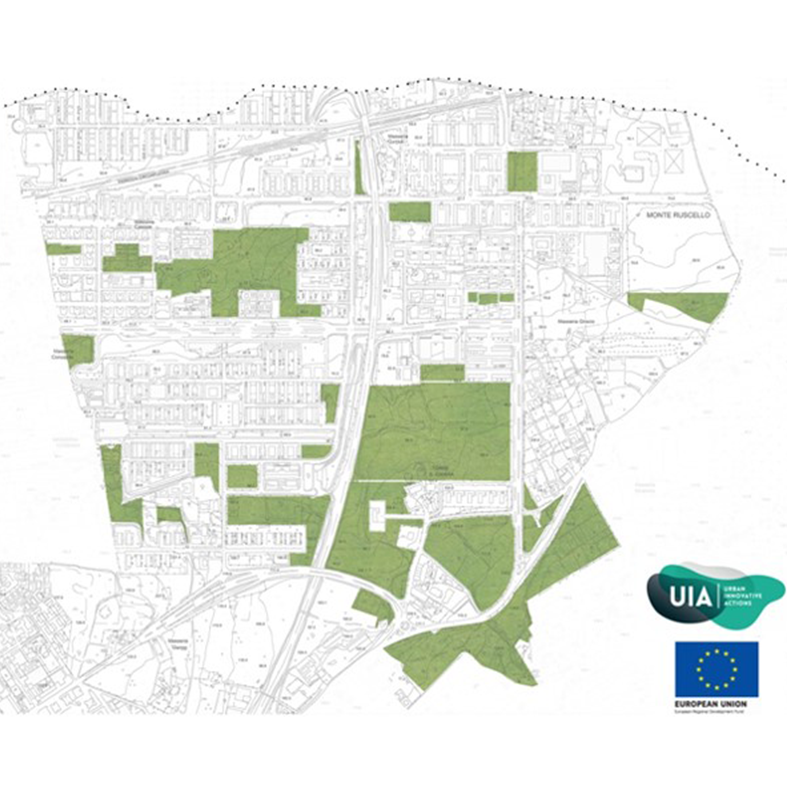
This contribution aims to frame the case of the Monterusciello district, in the northern part of the territory of Pozzuoli, for which complexes and numerous administrative acts have been drawn up in order to activate a virtuous planning process for the peripheral city area. The main objective was to recover the territorial identity through urban development and regeneration, intervening to solve environmental-geological problems as well as the injuries inflicted by unauthorized and industrial decommissioning.
To do this, the municipal administration has tried to go beyond merely localised interventions, seeking to multidisciplinarity through systemic practices. This type of approach has the advantage of triggering a transversal diffusion of the benefit, positively influencing the social fabric and intervening, even in an unconventional way, on public space.
The intervention on Monterusciello, considered as public new town, focuses on the scale of the urban-rural territory, acting on the built environment in order to equip each block of green spaces, respecting the natural slope and taking in account the perspective axes, also ensuring a improvement in terms of multi-level services. Despite the efforts, however, the inhabitants have not been able to glimpse in the new urban centrality a real stable settlement, but a peripheral and not definitive reality, unlike Pozzuoli. This confirms the social and economic complexity of the area with which each project must always deal.
Downloads
Downloads
Published
Issue
Section
License
Gli autori che pubblicano su questa rivista accettano le seguenti condizioni:- Gli autori mantengono i diritti sulla loro opera e cedono alla rivista il diritto di prima pubblicazione dell'opera, contemporaneamente licenziata sotto una Licenza Creative Commons - Attribuzione che permette ad altri di condividere l'opera indicando la paternità intellettuale e la prima pubblicazione su questa rivista.
- Gli autori possono aderire ad altri accordi di licenza non esclusiva per la distribuzione della versione dell'opera pubblicata (es. depositarla in un archivio istituzionale o pubblicarla in una monografia), a patto di indicare che la prima pubblicazione è avvenuta su questa rivista.
- Gli autori possono diffondere la loro opera online (es. in repository istituzionali o nel loro sito web) prima e durante il processo di submission, poiché può portare a scambi produttivi e aumentare le citazioni dell'opera pubblicata (Vedi The Effect of Open Access).