From inclusive design to the right to the city
DOI:
https://doi.org/10.6093/2281-4574/12578Abstract
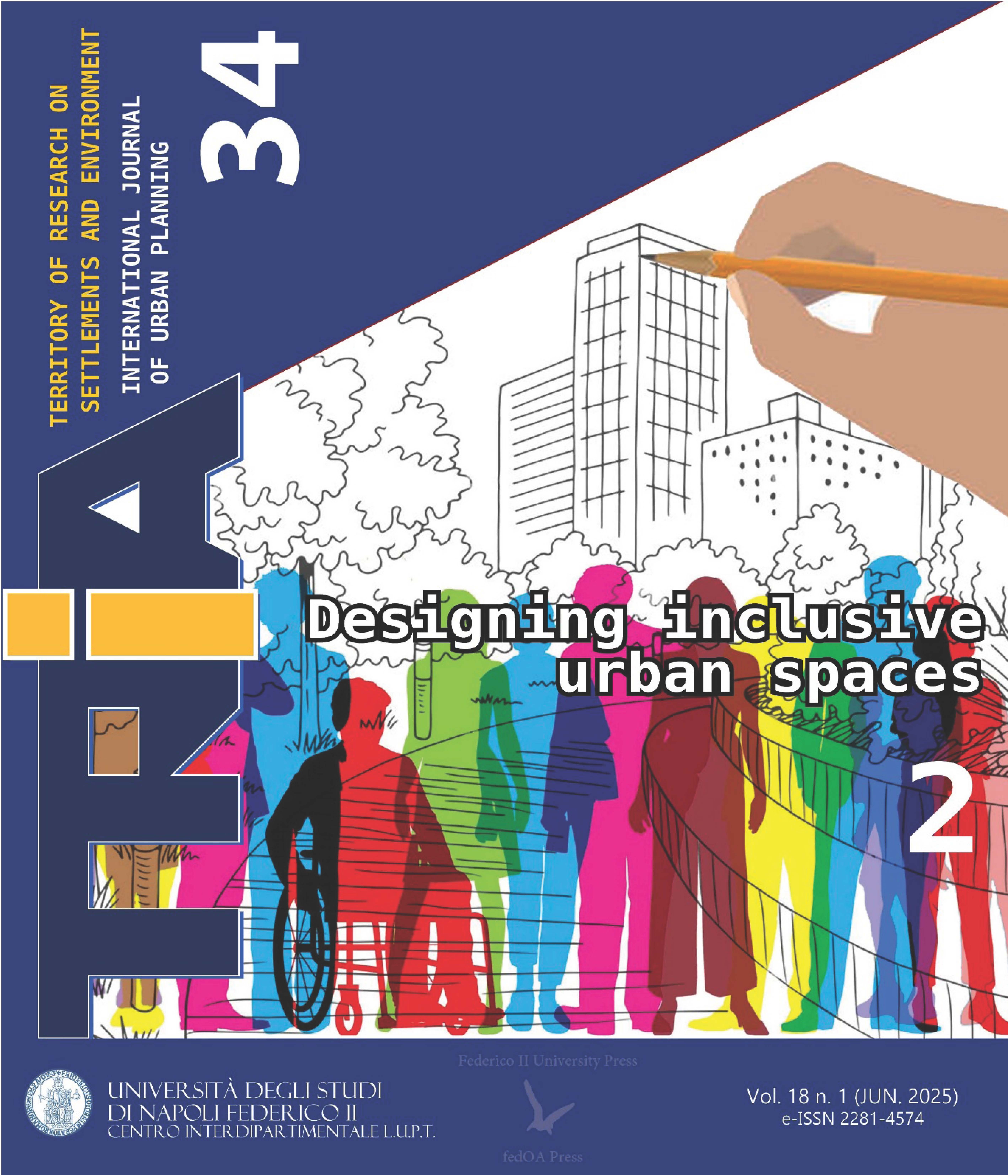
In light of the transformations affecting contemporary cities—marked by environmental pressures, social polarization, and demographic shifts—this contribution offers a theoretical and methodological reflection on the concept of inclusive design as both a critical and operational tool for the governance of urban space. Starting from a renewed reading of Henri Lefebvre’s “right to the city,” the text explores the multiple meanings that urban inclusivity has assumed in recent debates: from full physical and sensory accessibility to the integration of neurodivergent subjectivities, from perceived urban safety to spatial justice, from collaborative planning to gender-sensitive urbanism and LGBTQIA+ identities. These instances, still fragmented across normative frameworks and governance models, are brought together within a shared interpretative framework that unites ethical, design, and political dimensions. The contribution highlights the urgency of overcoming adaptive approaches aimed at “special categories” in favor of a city model that is welcoming to all—conceived as a relational and adaptive system, capable of responding to a plurality of needs, experiences, and forms of urban presence. In this perspective, inclusive design emerges not merely as a technical solution but as a transformative practice grounded in the co-production of space and the recognition of differentiated inhabitant needs. Ultimately, the essay argues that inclusion must not be treated as an ancillary option but rather as a guiding principle for the city of the future, rethinking dwelling, representation, and access in terms of social equity, cultural pluralism, and collective rights.
Downloads
Downloads
Published
Issue
Section
License
Copyright (c) 2025 Antonio Acierno

This work is licensed under a Creative Commons Attribution 4.0 International License.
Gli autori che pubblicano su questa rivista accettano le seguenti condizioni:- Gli autori mantengono i diritti sulla loro opera e cedono alla rivista il diritto di prima pubblicazione dell'opera, contemporaneamente licenziata sotto una Licenza Creative Commons - Attribuzione che permette ad altri di condividere l'opera indicando la paternità intellettuale e la prima pubblicazione su questa rivista.
- Gli autori possono aderire ad altri accordi di licenza non esclusiva per la distribuzione della versione dell'opera pubblicata (es. depositarla in un archivio istituzionale o pubblicarla in una monografia), a patto di indicare che la prima pubblicazione è avvenuta su questa rivista.
- Gli autori possono diffondere la loro opera online (es. in repository istituzionali o nel loro sito web) prima e durante il processo di submission, poiché può portare a scambi produttivi e aumentare le citazioni dell'opera pubblicata (Vedi The Effect of Open Access).