Archives
-

Fuori Luogo Journal of Sociology of Territory, Tourism, Technology - Special Issue Engineering the Future Sociologically: a Call to Delve into Environmental Education Enhanced by Technological Innovations
Vol. 22 No. 1 (2025)The special issue frames scientific reflections within the ambivalent horizon of “smart” technologies: AI, XR and IoT are portrayed as powerful enablers of immersive simulation, real-time analysis and personalised learning, yet never as socially innocent devices. Innovation is treated as socially constructed and embedded in asymmetrical distributions of resources, competences and voice; consequently, the digital turn in environmental education may reproduce—if not intensify—pre-existing inequalities. The editorial thus calls for a rigorously sociological gaze capable of linking technical affordances to power relations, infrastructural materiality and the politics of knowledge.
The guest editors Norberto Albano, Sandro Brignone, and Carmine Urciuoli outline an eco-humanistic paradigm intended to govern technological ambivalence under conditions of planetary crisis. They situate environmental education at the crossroads of sustainability agendas and social justice, arguing that advanced technologies can broaden access and foster ecological awareness only if coupled with critical literacy, institutional safeguards, and a rights-based orientation. The overarching claim is that sustainability is not an external constraint to be appended to technology, but an emergent property of socio-technical systems shaped by governance, design choices and collective responsibility.
Within this architecture, the interview with David J. Gunkel functions as a conceptual hinge rather than a mere closing dialogue. By urging readers to move beyond inherited dichotomies—subject/object, anthropomorphism/determinism—Gunkel reframes AI as a philosophical and political problem of categories, accountability and relational ontology. The resulting pedagogy is one of disciplined problematisation: educating with and about AI entails making assumptions explicit, recognising uncertainty, and re-designing the dialogue between engineering and the social sciences so that ethical and ecological stakes are addressed upstream, not retrofitted downstream.
-

Fuori Luogo Journal of Sociology of Territory, Tourism, Technology - Special Issue Combining Safety and Equity in the Post-Covid City: New Trends between Local Policies and Bottom-Up Practices
Vol. 19 No. 2 (2024)The special issue of Fuori Luogo examines urban dynamics in the post-Covid context, focusing on the interplay between safety and equity. Edited by Gabriele Manella and Madalena Corte-Real, it highlights how cities, shaped by neoliberal trends, face growing inequalities exacerbated by the pandemic. Drawing on diverse case studies from Europe and beyond, the contributions explore themes such as governance, migration, tourism, healthcare, and child-friendly urban planning. By intertwining empirical research and theoretical reflections, the issue emphasizes the importance of inclusive policies and grassroots practices to foster resilient, equitable cities. It concludes with a critical reflection on urban sociology’s role in addressing these challenges.
-
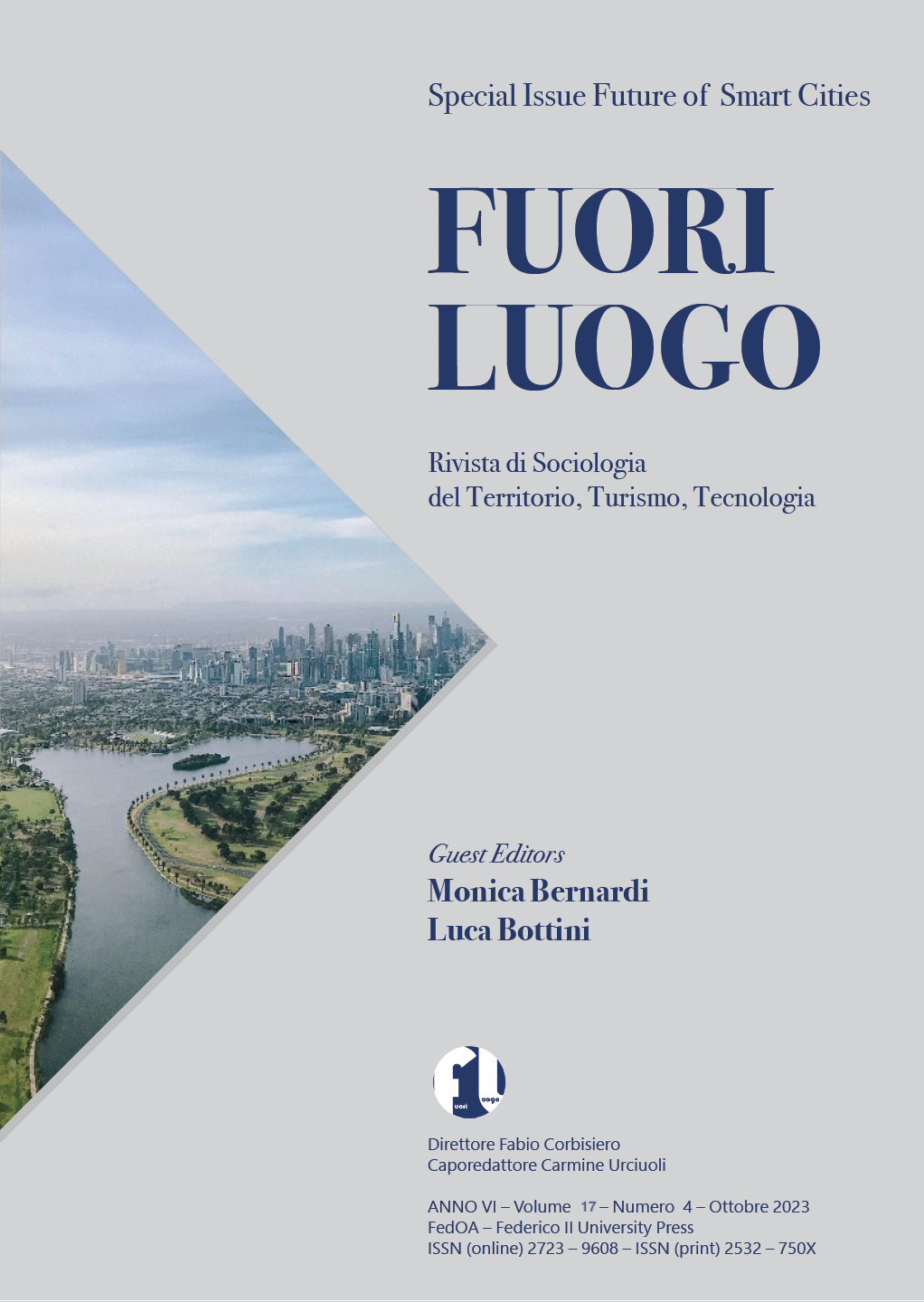
Fuori Luogo Rivista di Sociologia del Territorio, Turismo, Tecnologia
Vol. 17 No. 4 (2023)The smart city paradigm, a focus of local governments for over a decade, aims at harmonizing urban growth with sustainability and enhancing citizens' quality of life. This paradigm, evolving since the early 2000s, has shifted from a technology-centric to a more citizen-centric approach, emphasizing sustainable and eco-friendly practices and inclusive governance. With ongoing urbanization, cities face increasing demands for resources, necessitating new governance models. The smart city concept has evolved to address these challenges, initially emphasizing technology's role in optimizing urban systems, later shifting towards citizen engagement and sustainability. However, climate change, exacerbated by urbanization since the Industrial Revolution, poses new challenges to this paradigm. Cities are now pivotal in promoting decarbonization and energy transition. This special issue, originating from the 2022 Bozen conference, explores smart cities in a climate-neutral scenario, focusing on urban sustainability. It includes seven contributions discussing smart city challenges and adaptations for policymakers in decarbonization and environmental sustainability. The issue examines various aspects, from technology and governance to social justice and energy transition, and emphasizes the importance of interdisciplinary approaches in creating sustainable urban environments. It concludes with insights on the complexity of smart cities, the role of local governance, data ownership, and climate management, highlighting the need for interdisciplinary research and innovation in developing resilient cities.
-

Fuori Luogo Journal of Sociology of Territory, Tourism, Technology - Special Issue Distances
Vol. 15 No. 2 (2023)The text delves into the sociological aspect of social distance, defining it as a subjective perception that significantly influences human relationships. It outlines how social distance is not merely about the physical space between individuals but also encompasses the degree of intimacy and confidence shaped by cultural, gender, and personal preferences. The sociological journey of this concept traces back to the works of Park and Burgess, who built upon the ideas of Tarde and Simmel, showcasing its prevalence in examining the nuances of human relationality. Social distance is portrayed as a critical factor in urban settings, such as neighborhoods, where it can dictate the strength and duration of relationships beyond familial ties.
In addressing these multifaceted implications of social distance, the text advocates for an integrated approach to mitigate inequalities and foster social cohesion. It emphasizes the need for collaborative efforts across sectors and levels of governance to address structural barriers and promote equality.